
Grand Traverse MI-VINE Coverage
Michigan calls its service MI-VINE, short for Michigan Victim Information and Notification Everyday. It is a free and confidential custody and court information system available by phone, online, and supported notification methods. Participating Michigan county jails can report events such as release, transfer, and escape. MDOC also takes part in the statewide framework for state-prison custody and release notifications.
Grand Traverse County publishes a Victim Notification page that directs users to MI-VINE. Still, the live VINELink agency selector must be checked before claiming that a particular Grand Traverse jail record is present. The research did not find a state promise that every historical local release remains searchable or that one exact “released” label always appears. Availability, event wording, and fields come from the current reporting agency feed.
Coverage follows the custodian. A county-jail record may describe a Grand Traverse release or transfer. An MDOC record concerns state prison or state supervision. VINELink does not replace the Sheriff release log, OTIS profile, or court order, and it is not the Bureau of Prisons locator for federal custody.
Search Grand Traverse VINELink Records
Start at VINELink and search for one person. Gather the full name and any known booking or offender identifier first. A date of birth or other offered field can help resolve close matches, but the live form controls which refinements are available. Never choose a result from the name alone when multiple records appear.
- Open VINELink and select Michigan as the state.
- Choose the custody or offender search offered in the live interface.
- Enter the person’s name, booking number, or other available identifier.
- Compare all displayed identifiers and the reporting agency. Make sure the record belongs to the expected Grand Traverse or MDOC episode.
- Open the matching record and read the current custody status, agency, and latest event.
- If the result reports release or out-of-custody status, save the event details and confirm them with the reporting agency’s record.
- If no result appears, call MI-VINE support and the last known facility. Do not treat absence as proof that no booking or release occurred.
The Grand Traverse County released-inmate search path is useful when the last custodian is uncertain. It separates county jail, MDOC, federal, immigration, and court sources. VINELink works best once the correct person and likely reporting agency are already known.
The official VINELink search interface begins with state selection and a person search:
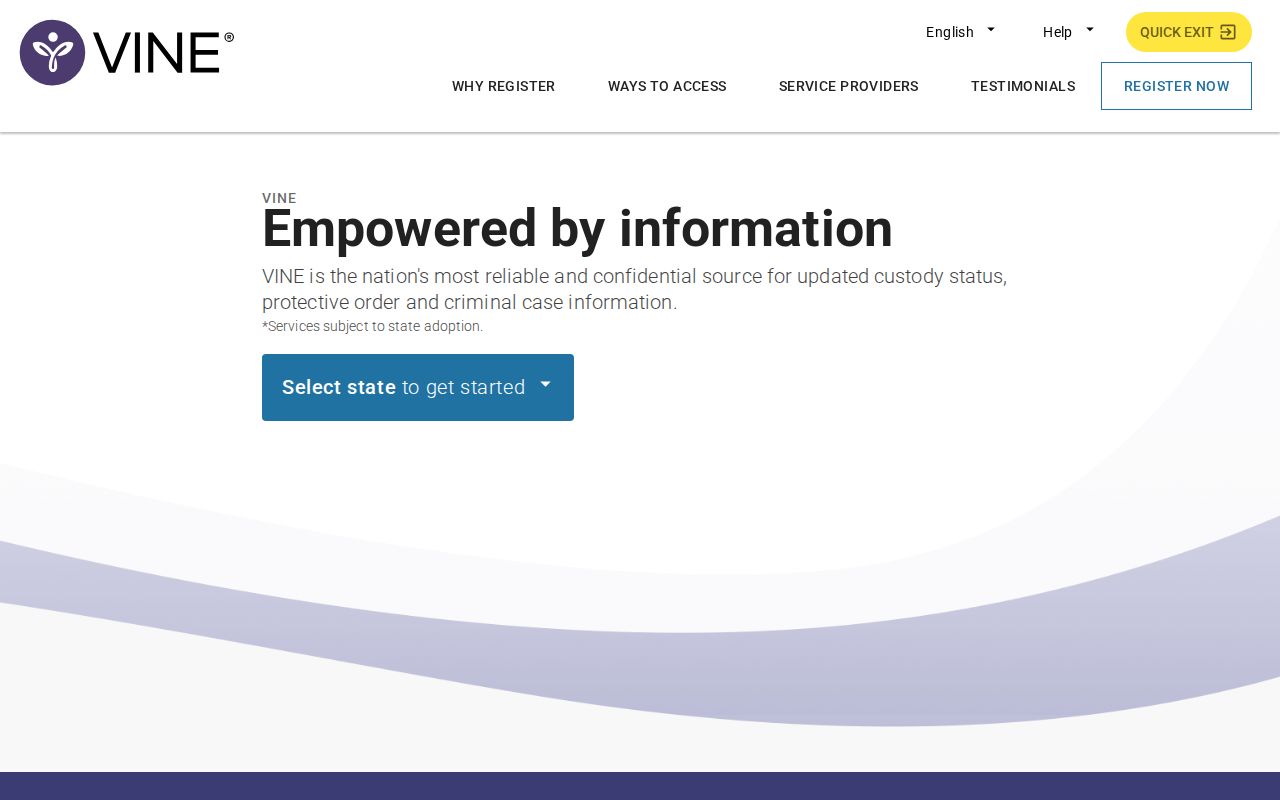
The image shows the correct starting point, but a live match still requires a careful identity and agency check before any custody event is accepted.
Grand Traverse VINELink Release Fields
VINELink fields can vary by agency and record. Michigan does not publish a guaranteed Grand Traverse released-result label or archive period. Read only what the current matching result displays. The event can identify a custody change, but a complete county release record contains more detail than a notification interface.
| Field | How to read it |
|---|---|
| Name and identifier | Use them with other details to distinguish the correct person and custody episode. |
| Reporting agency | Shows which jail or corrections system supplied the event. |
| Current custody status | Read the exact live wording. Do not convert an absence into a release finding. |
| Latest event | May describe release, transfer, escape, or another reported change. |
| Facility or location | Identifies the reporting place when supplied; it is not always a present-location guarantee. |
| Release information | Use the displayed event as a lead, then obtain exact time, type, and destination from the agency record. |
| Notification options | Phone, text, email, or app may be offered for selected events. |
Transfer and release are distinct. A transfer alert means custody changed hands. It does not establish a return to the community. When Grand Traverse Corrections transports a sentenced person to MDOC, the county custody episode ends, but state custody begins. The Sheriff movement record and OTIS then form the correct trail.
Register Grand Traverse Release Alerts
Registration begins from the correct person record. Choose each event that matters and each contact method the live system offers. Phone, text, email, and app notifications can behave differently. The notification is tied to an event reported by the agency, so correct person selection is essential before contact details are entered.
- Open the matching Michigan custody record and choose the notification or registration option.
- Select the release, transfer, escape, or other offered event types needed for that record.
- Add a phone number, text number, email address, or app method as available.
- For a telephone registration, create a four-digit PIN that can be recalled when the automated call arrives.
- Review the live registration terms, event choices, and retry language before completing enrollment.
- Keep contact information current. A changed number or email address can prevent a notice from reaching the registrant.
MI-VINE’s statewide number is 800-770-7657, and TTY service is 866-847-1298. If a PIN is forgotten, call the statewide number and press zero for help. Representatives are available around the clock according to the Michigan materials. Text and email normally send one notice for an event and do not use the phone PIN.
Grand Traverse VINE Phone PIN
The telephone PIN is a distinct part of Michigan’s VINE workflow. When an automated call arrives, listen to the message and enter the four-digit PIN followed by #. That action acknowledges the call and stops repeat calls for that reported event. It does not unlock a record, change custody status, or serve as an offender identifier.
If the call goes unanswered, MI-VINE may leave a message and keep calling until the PIN is entered or the retry period ends. The official Michigan VINE brochure version reviewed describes retries for up to 72 hours. Other brochure language may use a shorter period, so the live registration terms control.
This phone behavior is not a 72-hour release roster. It is a delivery rule for one alert tied to one record. Text and email do not require the phone PIN and should not be expected to repeat in the same way.
Why does VINE keep calling? The event notice may not have been acknowledged. Enter the chosen PIN plus # after hearing the message.
Grand Traverse State Release Alerts
For a person committed to MDOC, use MI-VINE as a notification channel and OTIS as the public offender-status source. OTIS can show Current Status, Date Paroled, Assigned Location, supervision dates, and sentence-level discharge information. “Date Paroled” documents actual prison exit onto community supervision. An “Earliest Release Date” on a prisoner profile is only the first date when the Parole Board has jurisdiction, not a promise that release occurred.
State-prison victims seeking parole-hearing or decision notices may also need separate registration with MDOC Crime Victim Services at 877-886-5401. That state process is not the same as choosing a standard VINELink custody alert. Use the route that matches the event needed.
- Parole
- Physical release from state prison while MDOC community supervision continues.
- Discharge
- The end of MDOC jurisdiction for the sentence.
- Transfer
- A move from one custodian or facility to another, not a community release.
- Notification
- An automated message about an agency-reported event, not the underlying official record.
Grand Traverse VINELink Limits
VINELink can be fast, but its limits matter. It depends on data reported by participating agencies. A new event can lag behind the real-world action. Michigan does not promise a fixed public retention period for a Grand Traverse released result. A person may also be missing because the wrong name form, agency, or custody system was searched.
VINELink is not the BOP Inmate Locator. For a verified federal prison episode, the BOP locator can show “Released” or “Not in BOP Custody” with a release date. That proves BOP custody ended, not that every hold or term of supervision ended. ICE has a separate locator for current detainees and people released from ICE custody within its recent window. Neither source should be used for an ordinary county-jail event without a movement record pointing there.
The Michigan sex offender registry is also not a substitute. It covers only people required by law to appear in that offense-based registry. Absence from it does not disprove a jail stay, release, or conviction. Keep the search tied to the custody system that actually held the person.
Note: A missing VINELink result has limited meaning and should lead to the facility, Sheriff record, court file, or correct receiving agency.
Confirm Grand Traverse VINE Events
For a Grand Traverse jail event, call Corrections at 231-922-4532 during Monday through Friday hours of 8 a.m. to 4 p.m., or 231-922-4530 after hours. Ask whether the person is still present and whether a release or transfer date and destination can be disclosed. Then request the release log, jail card, or movement entry through Sheriff Records or FOIA.
The Sheriff Records Division is at 851 Woodmere Avenue, Traverse City, MI 49686, with telephone 231-995-5000 and weekday hours of 8 a.m. to 4 p.m. Ask for the booking date and number, release date and exact time, release type, and receiving agency if transferred. The court register of actions and signed order explain the legal authority, though they may not show the minute of physical exit.
For an MDOC event, compare the alert with OTIS and request MDOC records when the public result is too old or incomplete. The strongest confirmation joins the custody event to its legal or receiving-agency record. That approach preserves the speed of MI-VINE without asking an automated alert to prove more than it can.
Save the reporting agency, event wording, record identifier, and notice time when an alert arrives. Those details help the office locate the right event if the status later changes or drops from public view. Ask the agency to correct an agency-supplied error. A court-derived error should go to the court, while an MDOC status issue should go to the supervising office or records unit shown by the official corrections directory.