
Grand Traverse Parole and Probation
Release from physical custody does not always end government supervision. A person paroled from a Michigan prison has left the institution but remains under the Michigan Department of Corrections. MDOC probation is a court-ordered community sentence administered by the same state agency. The 86th District Probation Department handles a separate class of local district-court cases. Its own description calls probation a judicial sentence that lets a person live in the community under officer supervision.
The label matters because it determines the correct record, office, and completion event. A jail release record can prove that someone left Grand Traverse County Correctional Facility, but it may not identify every later supervision detail. OTIS can show a state parolee or probationer. A district-court order and the local probation department address district probation. The court or agency record should be matched to the same case rather than treating any community status as parole.
| Status | What it means | Best verification |
|---|---|---|
| Parole | Physical release from an MDOC prison with state supervision still active | OTIS Current Status, Date Paroled, Assigned Location, and the MDOC office |
| MDOC probation | Court-ordered community supervision administered through MDOC | OTIS Probationers filter, court order, and MDOC office |
| District probation | Local judicial sentence supervised by the 86th District Probation Department | District-court record and local department |
| Community Corrections | Court-approved supervised alternative that may include tether, placement, or treatment | Court order and program confirmation |
A few terms keep these records clear.
- Parole
- Community placement after state-prison release while MDOC authority continues.
- Probation
- A court sentence served in the community under stated conditions and officer supervision.
- Discharge
- The recorded end of supervision or MDOC jurisdiction for the relevant sentence.
- Absconder
- A supervised person reported as failing to comply or report and being sought.
Verify Grand Traverse Post-Release Supervision
The Michigan OTIS search is the main public route for MDOC parole and probation. It includes people now under state supervision and people within the limited public period after their most recent discharge. OTIS does not include a person who served only a county-jail sentence. When the supervising system is uncertain, the court record can show whether the sentence imposed parole-related state jurisdiction, MDOC probation, district probation, or no supervision at all.
- Search by the six-digit MDOC number when known. Otherwise, use the full name and compare identity details carefully.
- Select Parolees or Probationers when the likely status is known. Use All if the supervision type is uncertain.
- Open the matching profile. Read Current Status, Assigned Location, Supervision Begin Date, Supervision Discharge Date, and Date Paroled.
- Check the active and inactive sentences against the Grand Traverse court file. A court file number helps tie the state profile to the right case.
- Contact the office in the MDOC Region 2 directory to question a supervision entry or find the durable local route.
- For district probation, contact the 86th District Probation Department and obtain the probation order or later discharge entry from the court.
OTIS uses precise status language. “Parolee” is proof of prison release into supervision when it is paired with Date Paroled. “Discharged” means MDOC jurisdiction for that sentence has ended. A future Supervision Discharge Date is an endpoint shown by the system, not proof that discharge already occurred.
The official OTIS form shows the status filters used for a Grand Traverse supervision search.
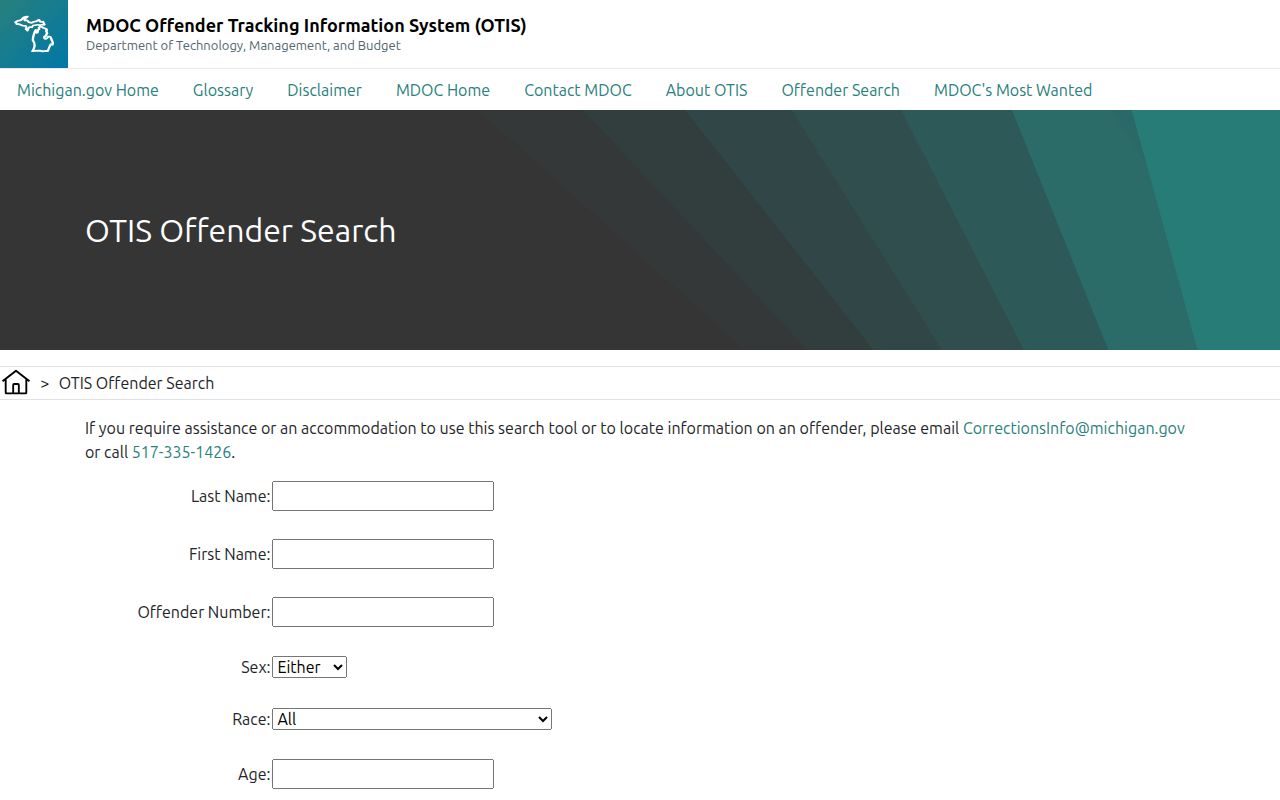
The form separates parolees, probationers, discharged people, and absconders, so the selected filter changes what a no-result can mean.
Note: OTIS generally keeps public information for three years after the most recent supervision discharge, so older cases need agency or court records.
Grand Traverse State Supervision Office
Grand Traverse County falls within MDOC Region 2. The state directory is the stable source because the county also publishes a named MDOC agents page and individual assignments can change. No official general public walk-in routine or office hours were found, so a caller should confirm access before traveling.
The office can address state supervision questions, but it does not replace the sentencing court for an error that came from a judgment. MDOC states that court-derived conviction or sentence facts should be corrected through that court. Supervision or absconder-status errors should go to the supervising office. General corrections questions can be sent to correctionsinfo@michigan.gov.
The MDOC Region 2 directory provides the Grand Traverse state office entry.
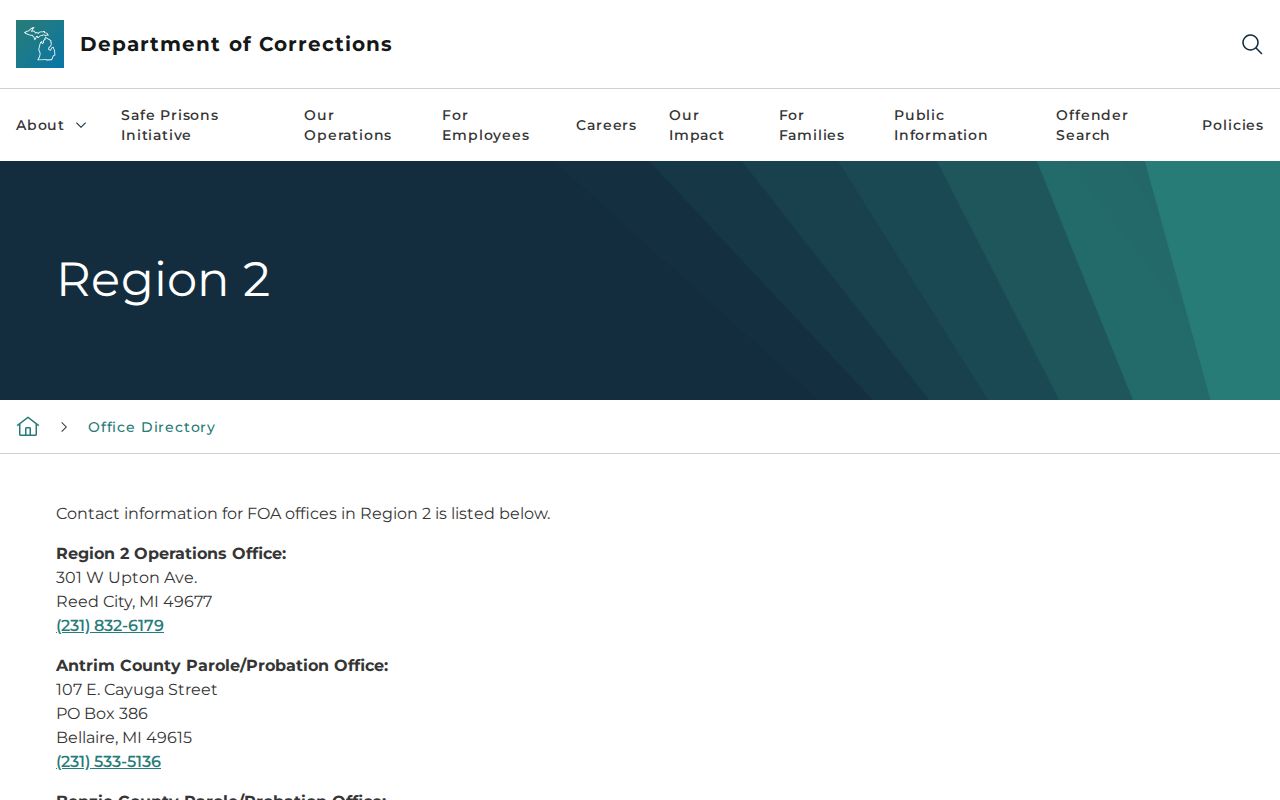
This directory entry is the best starting point when a current officer assignment or direct line is not known.
Grand Traverse Absconder Status
OTIS offers separate Parole Absconders and Probation Absconders filters. The status is more specific than a missing appointment. ABSCOND1 identifies a parolee reported as failing to report and being sought by MDOC. ABSCOND2 identifies a probation absconder whose case remains tied to the sentencing county. In either case, Assigned Location is a supervision area, not a reliable statement of the person’s present whereabouts.
MDOC maintains an Absconder/Escapee Tip Line at 517-755-0855 and also publishes a Most Wanted page. Research found no separate named Grand Traverse County absconder or warrant list. That gap should not be filled with an unofficial list. A person checking an alleged violation should use OTIS, the supervising office, and the court case tied to that order.
Supervision conditions vary by order. A violation can prompt a court response, added controls, or a return to custody, but the mere existence of parole or probation does not prove a violation. MI-VINE is designed for custody and court notifications where supplied. It is not a complete public supervision history.
Grand Traverse Supervision Discharge
Supervision ends through an official discharge, expiration, or court action, depending on the system. For MDOC, the public profile may show a Supervision Discharge Date and sentence-level Discharge Date and Reason. The first can be a future endpoint. The second records a completed sentence event. The person’s current status and inactive sentence details should be read together.
For district probation, the court record is the durable source. Useful documents include the probation order, amended orders, register of actions, and probation discharge. Grand Traverse County court portals have known online limits tied to automatic set-aside work and Clean Slate compliance. A missing public result is not a discharge certificate. The clerk record may be required.
The broader Grand Traverse County released inmate search explains how to match a Sheriff exit record to the court or receiving-agency record. That two-record approach distinguishes release from the jail, parole from prison, and final discharge from all supervision.
Note: A county-jail release date, Date Paroled, and supervision discharge date mark three different events and should never be substituted for one another.
Grand Traverse Community Corrections Release
Grand Traverse Community Corrections creates a local middle path between ordinary jail confinement and an unconditional return to the community. After a court or board-determined period, officers may assess a person in jail, seek jail and probation approval, and petition the court for an early move into a supervised setting. The available forms described by the county can include tether, a residential or transitional placement, or treatment.
This route is not the same as parole. It also does not prove that a named person qualified merely because the program exists. Confirmation requires the court order and program record. A violation can return the participant to custody. For that reason, an exit from Grand Traverse County Correctional Facility under Community Corrections should be described as a supervised alternative, with its exact placement taken from official records.
The distinction is useful when a caller hears that someone has “been released” but the person remains in a structured setting. The Sheriff movement record proves the county-jail exit. The court order explains the authority and terms. Program staff can confirm the active placement when disclosure is allowed.
Two Grand Traverse Probation Offices
Grand Traverse County has both the MDOC Region 2 parole/probation office and the separate 86th District Probation Department. The state office handles MDOC parole and probation. District probation at 231-922-4590 administers local court supervision. Calling the wrong office can yield no matching record even when supervision is active elsewhere.
The district department reports general and Recovery Court staffing and an average general caseload of about 180. Those figures describe probation work, not the number of people released from jail. They should not be used to infer a release trend or identify an individual. The proper proof remains the probation order, the department with authority over it, and any later discharge entry.
A quick routing check starts with the case court and the order’s agency name. An MDOC number and OTIS profile point to state supervision. An 86th District order points to the local department. Community Corrections requires its own court-approved record. Keeping these routes separate prevents a “not found” response from being mistaken for no supervision.
If the order is not online, ask the correct clerk for the probation order and register of actions. The court record identifies who imposed supervision, while the supervising office confirms the active administrative record.