
Grand Traverse County Release Outcomes
A release is a physical custody event, but it is not one legal result. Someone at the Grand Traverse County Correctional Facility may leave after bond, time served, sentence expiration, dismissal, acquittal, probation, or another court order. Community Corrections may secure court approval for a supervised alternative. A sentenced person may instead be transported to the Michigan Department of Corrections. Another warrant can lead to a different jail, while a documented immigration hold may lead to federal custody. Only some of these paths put the person back in the community.
That distinction controls the next search. The Sheriff’s release or movement record shows when county custody ended and, when recorded, the destination. A court order shows the legal reason. OTIS, Michigan’s Offender Tracking Information System, becomes relevant only when MDOC has jurisdiction. The federal BOP locator and the ICE locator apply only after a federal or immigration path is identified. No single portal covers every Grand Traverse County release.
- Time served
- A jail term ends after credit and any lawful local sentence reduction are applied.
- Parole
- A state prisoner leaves prison but remains under MDOC supervision.
- Discharge
- MDOC jurisdiction over that sentence has ended.
- Detainer
- Another agency asks to take custody or receive notice before release.
Grand Traverse County Release Types
The words on the jail card, release log, court order, or OTIS profile matter. They show which authority acted and where to verify the next status. An arrest charge describes the booking, not the final result. A transfer also ends the person’s stay at the county jail, yet it does not prove freedom from custody.
| Recorded outcome | Meaning | Best next record |
|---|---|---|
| Bond or bail | Pretrial exit after payment and required conditions are processed | Sheriff timestamp and court bond order |
| Time served or expiration | Local sentence ended | Jail computation and judgment |
| Probation | Court-authorized community supervision | Probation order and supervising office |
| Parole | Prison exit under MDOC supervision | OTIS Date Paroled |
| Community Corrections | Approved supervised placement or program | Court order and program record |
| Transfer | County custody ended but another custodian received the person | Movement record and receiving agency |
A dismissal, acquittal, or amended order can also supply release authority. Death is a different custody-ending event and should never be described as an ordinary community release. The record’s disposition and destination should be read together.
Grand Traverse Bond Release Timing
Grand Traverse County gives a useful, local warning about bond. The county says most people are released the same day bond is posted, but court-ordered conditions can delay the actual exit for as much as several days. Those conditions must be processed before the jail can act. A payment receipt therefore proves payment, not the moment a person walked out.
The official Grand Traverse County bond information shows the source statement and available payment routes. The captured county page below documents that timing rule.
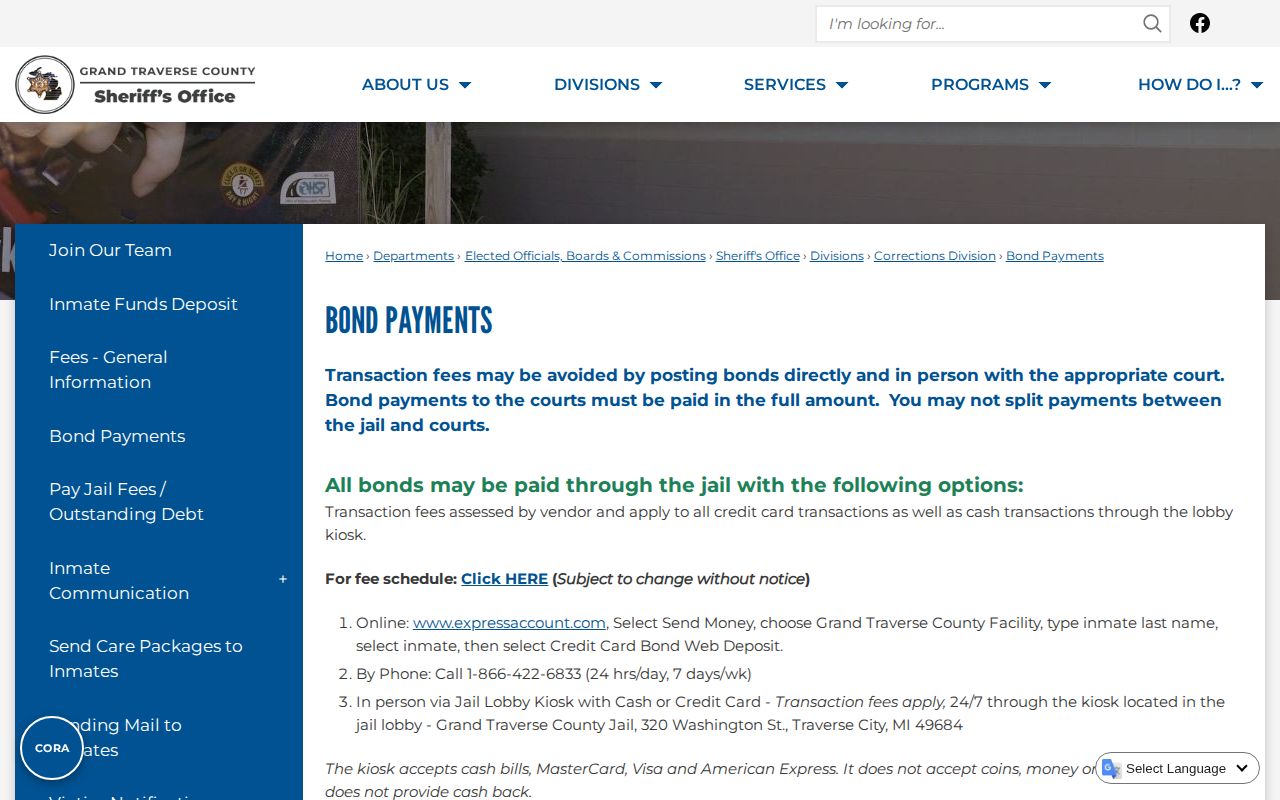
Keep the receipt, then ask Corrections whether all conditions cleared and whether the named person left. The court’s bond order explains the terms. The Sheriff release entry supplies the physical exit time.
Grand Traverse County Release Record Fields
A strong Grand Traverse County release record connects one admission to one exit. Give the Sheriff a full name, aliases, approximate booking period, date of birth when needed to distinguish names, and a booking or case number if known. Ask for both the booking tie-back and the movement entry. This prevents a release from one case or confinement from being attached to the wrong episode.
| Field | What it shows |
|---|---|
| Booking date and number | The admission episode tied to the exit |
| Arresting or committing agency | Who placed the person in county custody |
| Court and case number | The case linked to the confinement |
| Bond type and posting time | The payment event, when applicable |
| Release date and exact time | When county physical custody ended |
| Release disposition | Bond, court order, time served, sentence completion, or other reason |
| Destination or receiving agency | Community return, MDOC, another jail, or another custodian |
Charges at booking may appear as supporting fields, but they are not the court’s final disposition. A booking photograph can be requested if it exists and is disclosable. The jail card, booking sheet, release log, and movement record may hold different parts of the same Grand Traverse County release.
Request Grand Traverse Release Records
The Grand Traverse Sheriff’s Records Division receives identifiable release-record requests. The county offers an online FOIA form, fax, and mail. Michigan FOIA requires a request to describe an existing record well enough for the public body to locate it. The Sheriff does not publish a flat charge for a release record or booking photograph, so ask for electronic copies and an itemized estimate before costs are incurred.
- Identify the person, aliases, approximate booking period, and the Grand Traverse County Correctional Facility.
- Request booking date and time, booking number, release date and time, disposition, and transfer destination.
- Ask for the jail card, booking sheet, or movement log that links the admission to the exit.
- Use the online Sheriff FOIA form, or send the request by fax or mail.
- Request electronic delivery and an itemized fee estimate.
Sheriff Records is at 851 Woodmere Avenue, Traverse City, MI 49686. The phone is 231-995-5000, and posted hours are Monday through Friday, 8 a.m. to 4 p.m. Fax requests go to 231-995-5010. The agency may grant, deny, partly grant, or extend its response time under Michigan law. A response deadline is not a promise that production is complete on that day.
Note: Ask the FOIA coordinator to identify the record series when retention matters because no precise local public retention term was verified.
Grand Traverse Release Fees and Balances
Grand Traverse County may issue a jail debt statement at release. The county lists a $12 booking fee, a $10 warrant-processing fee, and sentenced-stay reimbursement of $40 for the first day and $20 for each later day. It also describes a 30-day payment-plan and collection timeline. A person found not guilty, or whose charges are all dismissed, can seek a refund of a paid booking fee through the county process.
Positive jail account balances are returned by debit card or check. ExpressAccount includes a “Show Inactive/released residents” choice for account payment, but that feature is not a public release search. It does not establish the release date, the reason, or the destination. Financial papers can support the chronology, yet only the Sheriff movement record directly documents the jail exit.
Note: Inmate Accounting handles debt-statement and payment-plan questions at 231-922-4539, while the Corrections line can address balance routing.
Grand Traverse Release Records Law
Michigan’s Freedom of Information Act, MCL 15.231 and following, governs access to many existing public-body records. Under MCL 15.235, a public body generally responds within five business days or issues one written extension of no more than ten additional business days. MCL 15.234 permits certain itemized labor, search, review, copy, media, and mailing charges. A deposit of up to half the estimate may be required when the estimate exceeds $50.
FOIA does not require an agency to create a new list or keep a record forever. Privacy and law-enforcement exemptions can apply, and nonexempt parts should be separated when reasonably possible. Clean Slate and set-aside rules can also change what appears in public court search results. Sealed, nonpublic, juvenile, and set-aside material may be unavailable. A missing web entry does not erase the need to ask the correct clerk or custodian.
Grand Traverse Release Court Gaps
Grand Traverse has two distinct online court limits. The 86th District Court reports restricted criminal-case extraction during automatic set-aside reconciliation. The local circuit criminal search, which is updated nightly, warns that not every case appears while the county meets Clean Slate requirements. MiCOURT is a statewide starting point, but its online display is informational rather than the official court record.
When a name or case is missing, contact the right clerk. Ask for the register of actions, judgment of sentence, bond order, dismissal, probation order, amended order, and any jail-credit or time-served notation. The court record explains legal authority. It does not always prove the minute that the jail physically released the person, so pair it with the Sheriff entry.
The Grand Traverse court record request page lists the request channels and county copy charges. The image below preserves that official route.
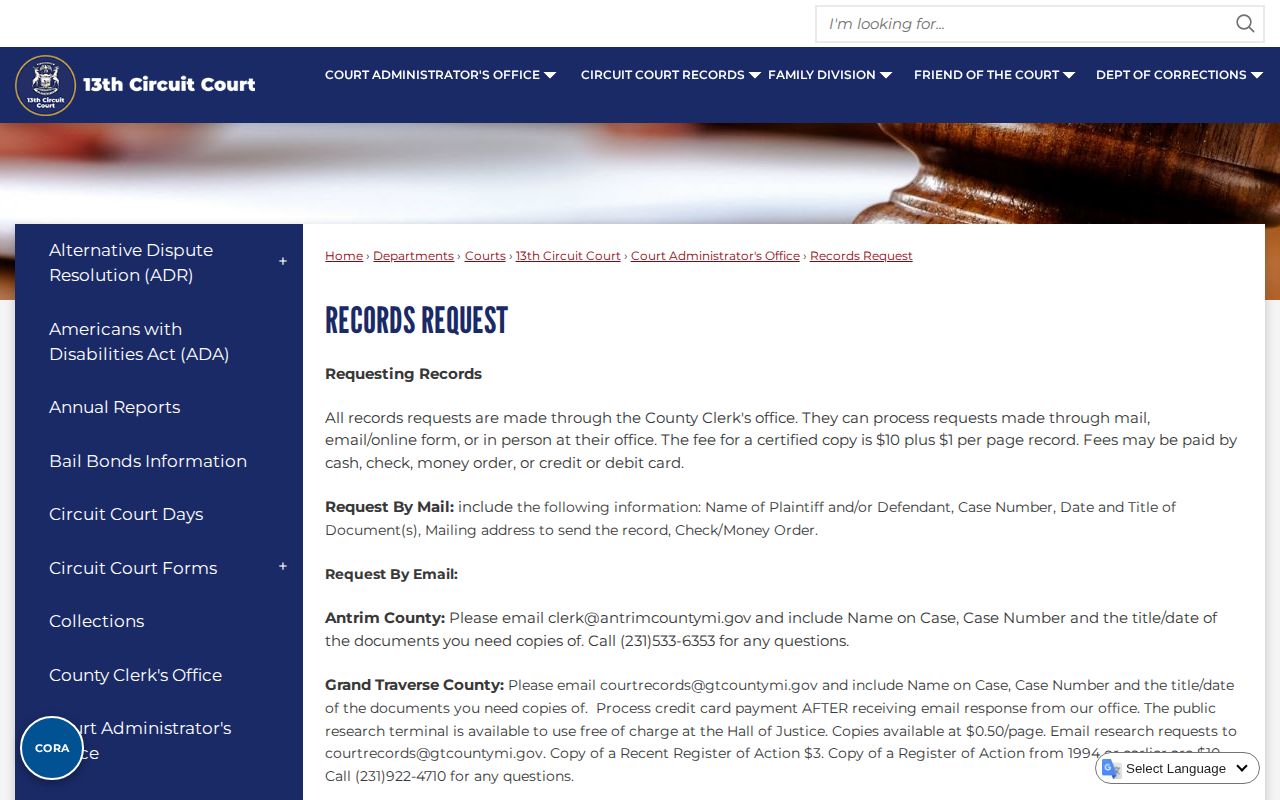
The County Clerk accepts mail, email, and in-person requests. A party name, case number, document title, and date help staff locate the correct Grand Traverse release-related order.
Find Grand Traverse County Released Inmates
The former official county “Inmate Information” endpoint returned a Custom404 when researched, and no verified county recent-release feed was found. Start with the last known custodian instead of treating a missing web result as proof. For a same-day answer, call Corrections and check the named person in MI-VINE if Grand Traverse appears in the live participating-agency selector. For documentary proof, obtain the release or movement record.
- Call Grand Traverse Corrections and ask whether the person is present or was released or transferred.
- Check MI-VINE for the exact person, facility, current status, and latest reported event.
- Request Sheriff release date, exact time, disposition, and destination through FOIA.
- Read the 86th District or 13th Circuit court orders for the legal cause.
- If transported to state prison, search OTIS. Use BOP or ICE only when the custody trail supports it.
Old events often require Sheriff, court, or MDOC records because public search windows can close. Keep each agency response with the name, identifier, and booking period used for the search.
The County Clerk accepts release-related court requests by mail, in person, or at courtrecords@gtcountymi.gov. Its office is at 280 Washington Street, Suite 206, Traverse City, and the records phone is 231-922-4710. Posted hours are Monday through Friday, 8 a.m. to 5 p.m. Grand Traverse lists copies at $0.50 per page, a recent register of actions at $3, and a register from 1994 or earlier at $10. Certification has a separate price.
Grand Traverse Released Offender Search
OTIS covers Michigan prisoners, parolees, MDOC probationers, and people discharged within its public window. It excludes county-jail-only people and city-lockup custody. Use a six-digit MDOC number when known. Otherwise search by last and first name, then narrow with sex, race, age, status, or marks, scars, and tattoos. Status filters include Prisoners, Parolees, Probationers, Discharged, and absconder categories.
The official MDOC OTIS search form shows the fields and status choices pictured below.
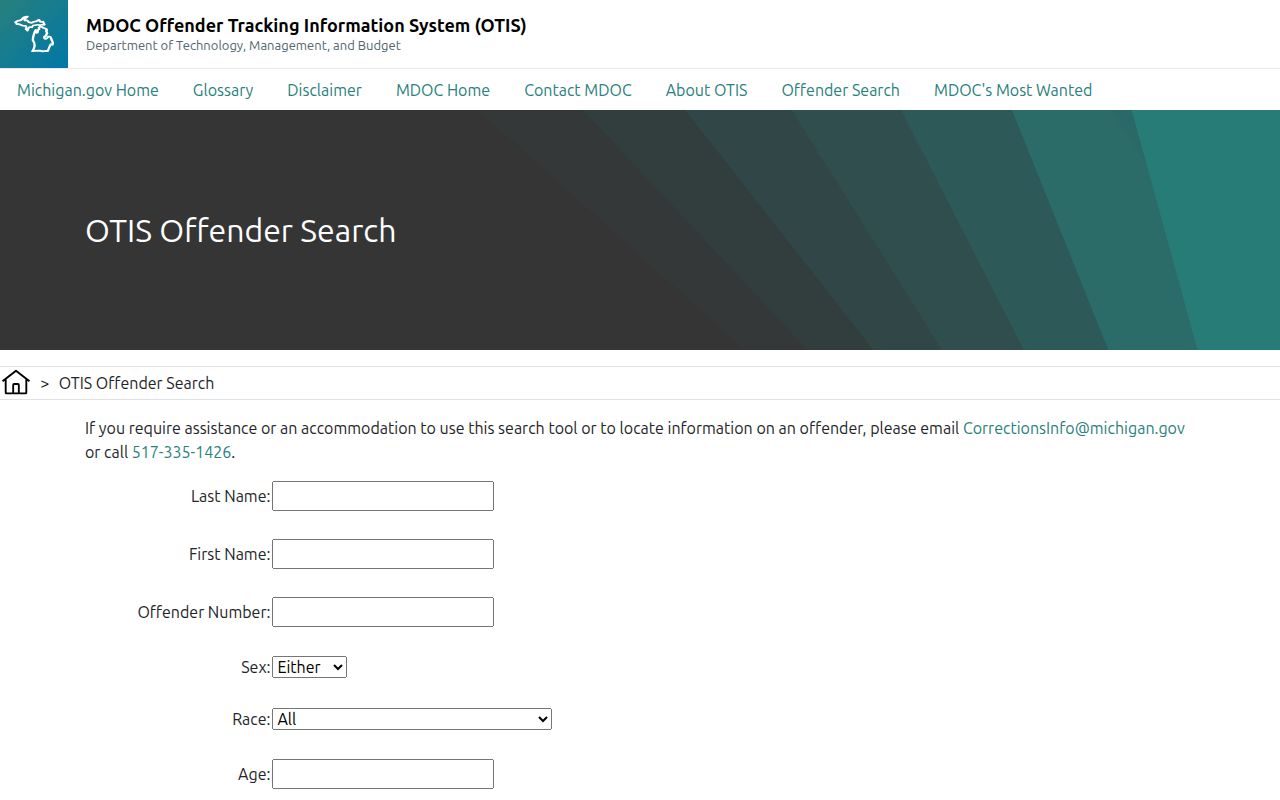
Open the matching profile and compare identifiers. Date Paroled records an actual prison exit to supervision. Current Status, Assigned Location, Supervision Begin Date, and Supervision Discharge Date describe the supervision record. A sentence-level Discharge Date and Discharge Reason show that MDOC jurisdiction ended. Earliest Release Date means eligibility for Parole Board jurisdiction, not a promised release.
OTIS generally retains public data for three years after the most recent supervision discharge. For an older state-prison release, request MDOC records and check the sentencing court. An Assigned Location is a supervision area, not a guaranteed present location.
Grand Traverse Supervised Release Alternatives
Grand Traverse Community Corrections documents a middle path between ordinary jail confinement and unconditional community release. Officers may assess a person in jail, obtain jail and probation approval, and petition the court for early release into tether, a residential or transitional setting, or treatment. The court must approve the move. A violation can result in a return to custody.
Confirm this outcome with the court order and Community Corrections record. Do not assume that a person qualified just because the program exists. State parole, MDOC probation, local district probation, and Community Corrections are separate systems. The Grand Traverse County Parole / Probation page distinguishes their records and offices.
Grand Traverse Release Transfer Routes
Corrections personnel operate the county jail, supply court security, and conduct statewide transports. Their duties include taking sentenced people to MDOC and retrieving people arrested on Grand Traverse warrants or court orders. This local transport role makes transfer a key explanation when a person no longer appears in county custody.
If a felony judgment commits the person to MDOC, allow for intake processing and search OTIS. A “Prisoner” status means the county movement was not a community release. A later “Parolee” status with Date Paroled confirms the prison-to-community event. For another county jail, ask the Grand Traverse release record for the receiving agency and then contact that agency. The movement destination is the bridge between the two records.
Grand Traverse Release Notification Search
MI-VINE can report custody changes from participating Michigan county jails and MDOC, including release, transfer, and escape events. Choose Michigan, match the person and reporting facility, and read the latest event. A release or transfer alert is a fast lead, but it does not replace a Sheriff log, OTIS profile, or court order. Michigan does not promise a fixed Grand Traverse released-result label or retention period.
Federal systems answer different questions. The BOP Inmate Locator searches federal records from 1982 forward and can show a release date with “Released” or “Not in BOP Custody.” That means BOP custody ended, not that all supervision or other custody ended. The ICE detainee locator accepts an A-number and country of birth, or exact name and country of birth, and can include people released from ICE custody during its recent public window. Use it only when a Grand Traverse movement record points to immigration custody.
USMS Prisoner Operations has no comparable public historical released-person locator. Identify the actual holding facility and federal court, then use BOP after commitment. No local BOP or ICE facility was verified in Grand Traverse County.
Grand Traverse Release Search Choices
The correct source depends on custody type and time. A live jail listing would answer who is currently held, but the former Grand Traverse inmate route is broken and no release archive is published. A Sheriff record is the main local proof. State and federal databases should not be used as substitutes when those systems never held the person.
| Situation | Source | What it can establish |
|---|---|---|
| Current county-jail question | Corrections phone | Present custody or a lead about release or transfer |
| Past county-jail exit | Sheriff FOIA record | Date, time, reason, and destination if recorded |
| State prison or supervision | OTIS and MDOC records | Prisoner, parolee, probationer, or discharge status |
| Legal reason for exit | District or circuit court | Bond, judgment, dismissal, probation, or amended order |
| Federal prison | BOP locator | Federal custody release date and status |
Can a missing name prove release? No. It can reflect a broken route, a transfer, the wrong system, an older record, a name mismatch, or restricted public access. Match the Sheriff exit record to the court or receiving-agency record.
Getting Home After Grand Traverse Release
The county publishes no verified jail release ride, voucher, fixed transit stop, exit door, family waiting point, or static weekend plan. Bay Area Transportation Authority is the official local public-transit trip-planning source. Use the current BATA maps and schedules from the jail address rather than relying on an old route claim.
Release time can shift while staff process court conditions, a bond, property, or a transfer. Confirm the actual exit before arranging a pickup. Family members should ask Corrections about current on-site instructions rather than assuming where to wait. A BATA route plan helps with travel after a confirmed community release, but it says nothing about whether the person has left custody.
Grand Traverse County Release Facilities
The Grand Traverse County Correctional Facility is the only local adult detention facility identified in the official county sweep. It holds the county adult inmate population under the Sheriff’s Corrections Division. A person can return to the community, enter a supervised alternative, or be moved to another custodian. County courts may also commit a person to an MDOC institution outside Grand Traverse County.
Grand Traverse County Correctional Facility: local Sheriff custody, with release or movement records held through Corrections and Sheriff Records.
State prisons, federal prisons, and ICE detention are systems serving individual cases, not verified local detention sites. Their locators become relevant only after the custody trail identifies that authority.