
Grand Traverse Scheduled and Actual Release
A future date is a planning point, not proof of an exit. For an MDOC prisoner, OTIS uses “Earliest Release Date / Parole Board Jurisdiction Date” and “Maximum Discharge Date.” The earliest date is when the Michigan Parole Board first gains authority to consider release. It is not an appointment or promise. If parole is granted and processing is complete, Date Paroled records the actual prison exit. If parole never occurs, the maximum date can govern, subject to lawful changes in the sentence.
Grand Traverse County jail dates work through a different system. A sentenced jail resident can have a time-computation record based on the judgment, jail credit, and applicable county good-behavior allowance. A pretrial detainee ordinarily has no sentence-expiration date. Bond acceptance, court conditions, dismissal, a new order, or transfer can change custody without a countdown ending.
“Released” can also mean transfer in a source system. Grand Traverse Corrections transports sentenced people to MDOC, and another warrant can lead to another jail. The movement destination must be read before calling the event a return to the community.
Find a Grand Traverse Release Date
Begin with the last known custodian. OTIS covers state prisoners and people under MDOC supervision, not jail-only sentences at Grand Traverse County Correctional Facility. The county’s former inmate endpoint is broken, so a local projected date requires the jail and court record rather than an online roster estimate.
- Identify whether the person is pretrial, serving a county-jail sentence, or committed to MDOC. The judgment and facility are the key clues.
- For MDOC custody, open the OTIS offender search. Use the six-digit MDOC number when known, or search by name and compare identifiers.
- Open the correct prisoner profile. Read Earliest Release Date / Parole Board Jurisdiction Date and Maximum Discharge Date in the exact terms shown.
- For a county-jail sentence, call Grand Traverse Corrections at 231-922-4532 during business hours or 231-922-4530 after hours. Ask for the sentence or time-computation record.
- Compare the jail computation with the judgment, amended judgment, and jail-credit notation from the sentencing court.
- After the expected date, verify the actual event through Date Paroled for MDOC or the Sheriff release or movement record for county custody.
The full Grand Traverse County released inmate search supplies the broader custody decision tree when the last facility is unclear. A current OTIS “Prisoner” result after someone leaves the county jail means the move was likely a transfer to state custody, not release to the community.
OTIS field definitions explain the release, parole, and discharge terms used in Michigan state records.
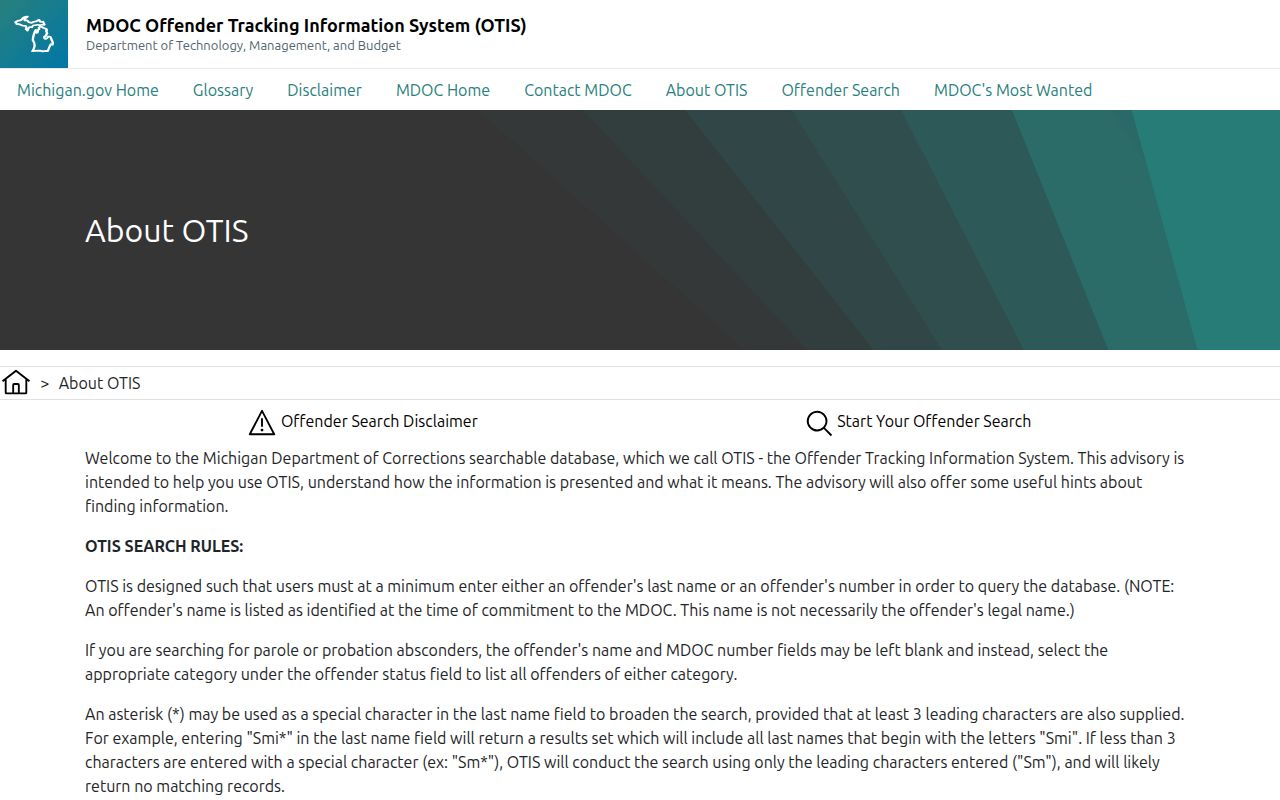
Those definitions show why eligibility, parole, and discharge must be treated as separate dates.
Michigan State-Prison Release Computation
Michigan uses indeterminate sentencing in most state cases. The court sets a minimum, while the statutory framework supplies a maximum. Under the modern truth-in-sentencing system, Michigan is not a “serve 85%” state. Covered assaultive offenses committed on or after December 15, 1998, and other covered offenses committed on or after December 15, 2000, require service of the full judicial minimum before parole eligibility. Modern prisoners do not shorten that minimum with good time or disciplinary credits.
MDOC truth-in-sentencing information states the full-minimum rule used for modern covered sentences.
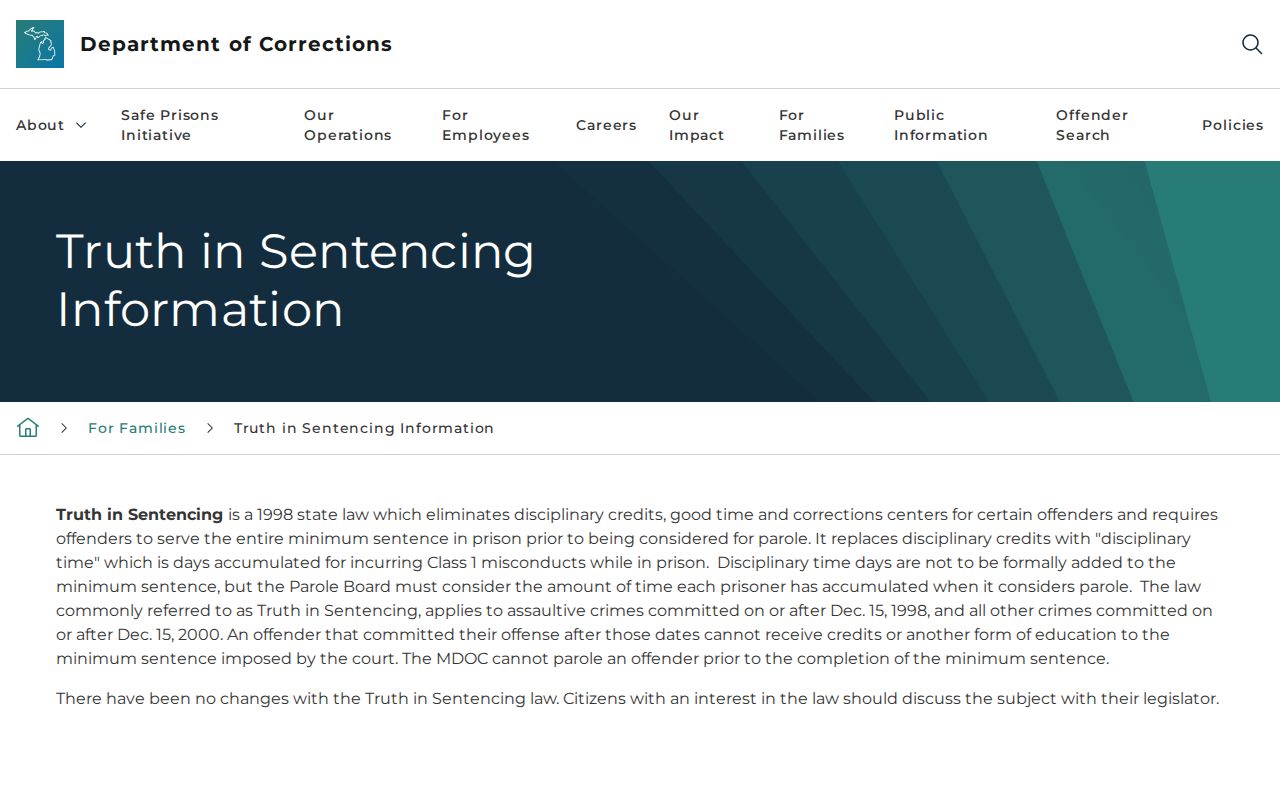
The state explanation supports reading the OTIS earliest date as parole jurisdiction after the applicable minimum, not as a reduced automatic release date.
Legacy cases need sentence-specific review. MCL 791.234 preserves applicable good-time or disciplinary-credit rules for certain older sentences. MDOC describes some eligible disciplinary-credit cases as earning five days per month, with up to two more days for exceptional conduct and possible loss for major misconduct. Crime date and governing law control. Consecutive minimum terms are added for parole-jurisdiction computation.
Note: Never apply a legacy credit to a modern sentence, or the modern full-minimum rule backward, without checking the offense date and judgment.
Grand Traverse Jail One-for-Six Credit
County-jail sentences use MCL 51.281 through 51.283, not MDOC truth in sentencing. Under MCL 51.282, a qualifying jail prisoner with no recorded rule violation receives one day of sentence reduction for each six days served. The Sheriff may set forfeiture rules for violations and may restore some lost time after a minor infraction. Posted jail rules and the individual time-computation record control the actual Grand Traverse calculation.
A simple calendar count can therefore be wrong. Start with the sentence imposed, subtract verified jail credit, and obtain the jail’s own computation of any one-for-six allowance. Then check for an amended judgment, another case, a warrant, or a hold. The Sheriff record is more reliable than an estimate made from the booking date alone.
A request can ask for the sentence/time-computation record, booking date, credited time, projected expiration, and any recorded forfeiture or restoration that affects the total. Pair that material with the judgment. The Grand Traverse Sheriff FOIA route accepts identifiable requests, while the court supplies the sentence authority.
Why Grand Traverse Release Dates Change
A projected date is based on the record available at that moment. Changes can come from the sentencing court, the jail’s credit calculation, prison discipline, parole action, or another agency. The reason should be documented rather than guessed from a vanished roster entry.
| Factor | Possible effect | Record to check |
|---|---|---|
| Amended judgment or jail-credit correction | Moves the computed minimum or local sentence end | Court judgment and jail time-computation record |
| Consecutive sentences | Adds qualifying minimum terms for parole jurisdiction | Judgments, sentence details, and OTIS |
| Misconduct or credit forfeiture | Can alter eligible legacy or county-jail credit and affect parole review | Agency computation and disciplinary record |
| Parole grant, denial, suspension, or rescission | Can permit, defer, or stop release before the person exits | Parole decision, OTIS, and Date Paroled |
| New warrant, detainer, or hold | Can lead to continued custody or transfer | Movement record and receiving-agency record |
| Appeal or new court order | Can revise the sentence or release authority | Register of actions and signed order |
A parole grant alone is not the door event. It may still be suspended before release because of misconduct or new adverse information. Date Paroled is stronger proof of actual prison exit. At the county jail, a bond receipt likewise proves payment, not physical release, because court conditions may delay processing.
Confirm a Grand Traverse Release Date
Use the record created by the agency that controlled the exit. For Grand Traverse County Correctional Facility, ask Corrections whether the person remains present and whether the outcome was a community release or transfer. The county Corrections Division page identifies the local custody office and its transport role. For documentary proof, request the release date and exact time, disposition, destination or receiving agency, booking number, and movement entry through Sheriff Records or FOIA.
For state prison, OTIS Date Paroled proves the parole exit. A sentence-level Discharge Date and Reason address the end of MDOC jurisdiction. If the public profile has aged out of OTIS’s general three-year post-discharge window, request the discharge certificate, time-computation record, parole decision, or Basic Information Sheet from MDOC FOIA.
MDOC FOIA accepts requests by email at MDOC-FOIA@michigan.gov, by mail to the MDOC FOIA Coordinator at P.O. Box 30003, Lansing, MI 48909, by telephone at 517-335-4194, or by fax at 517-335-4193. Include the person’s name, MDOC number, date of birth if known, and a focused date range. Current prisoner record questions also route through Corr_Records_Info@michigan.gov. Past prisoner records up to six years post release have a separate MDOC retention contact, but that routing phrase is not a universal destruction schedule.
For a Grand Traverse county-jail event, Sheriff Records can supply a different set of proof. Ask for the booking sheet or jail card, the release or movement log entry, exact exit time, disposition, and destination. A court judgment can explain the sentence and jail credit, yet it may not show when release processing ended. Using both records separates legal authority from the physical custody event.
The VINELink Release Check can provide a fast alert for a reported release or transfer when the agency participates. It should not stand alone as proof of the exact release time or destination. Michigan does not promise a fixed Grand Traverse result label or retention period in the public interface.
Note: A transfer alert confirms a change of custodian, while a release record must identify whether the person returned to the community.
Grand Traverse Pretrial Release Timing
A pretrial detainee does not have a sentence to count down. The court may set bond and conditions, modify the order, dismiss the case, or keep the person detained. Grand Traverse County says most people are released the same day bond is posted, but court-ordered conditions can delay actual exit for as much as several days. Payment therefore starts processing but does not establish a release timestamp.
For a current pretrial question, call Corrections and read the court’s bond order. The Grand Traverse bond page documents payment channels and warns that conditions can delay exit. The order explains legal authority and conditions. The Sheriff exit record supplies the minute physical custody ended. If another warrant or agency hold applies, the person may remain confined or move to another custodian even after the local bond is paid.
The former official county inmate endpoint is not a working source, and no official 24-hour or 72-hour release feed was found. That makes direct confirmation important. MI-VINE may offer a reported custody change if Grand Traverse appears in the live selector, but a precise release or transfer still needs agency corroboration.
For an old projected date, preserve the date as it appeared but obtain the final record. The County Clerk accepts requests for identified judgments, amended judgments, bond orders, and registers of actions. A register can show when the court changed the legal basis for custody. It still may not contain the minute a person crossed the jail door, so the Sheriff movement or release entry remains necessary.
When the court record and jail calculation conflict, ask each office to identify the source of its figure. A court can correct the judgment or jail-credit entry. The jail can explain its local time computation. MDOC handles the state sentence record after commitment. Keeping a dated copy of each response makes later changes easier to trace without treating an early estimate as final.
Three labels should remain distinct in saved notes. “Earliest Release Date” means Parole Board jurisdiction for an MDOC prisoner. “Date Paroled” marks actual prison exit to parole. “Maximum Discharge Date” is the outside state date shown by OTIS, subject to lawful sentence changes. For a Grand Traverse jail sentence, use the jail’s own projected expiration and final release timestamp instead of translating an MDOC label into the county system.